

Rules and ethics
Part of 10 questions to ask a franchisor UK before signing
10 questions to ask a franchisor UK before signing
Ten questions to ask a franchisor in the UK before signing, covering fees, territory and exit terms, plus the documents to check each answer against.
What to take away
- Ask for the disclosure pack and a draft franchise agreement before the first substantive call, not after it.
- Ten questions cover legal identity, trademark ownership, fees, territory, training, support, exit terms and the existing network.
- No UK statute compels a franchisor to issue a prescribed disclosure document; the British Franchise Association (BFA) code of ethics binds members to written disclosure of material facts.
- Every answer should come with a document you can check for yourself.
The gap UK buyers fall into
Franchising in the UK is governed by the contract, general commercial law and, for members, the BFA code of ethics. There is no statutory equivalent of the US franchise disclosure document. A franchisor can therefore decline almost any request without breaking a rule.
That does not make the request pointless. A vague answer is itself evidence. A franchisor unwilling to put a figure in writing has shown you how the relationship is likely to run.
Settle the groundwork first with vendor due diligence for franchise systems, so the legal identity and exit pricing are already documented. Questions land better when the other side can see you have done the reading.
Ten questions to ask a franchisor UK
Ask these in one sitting and write the answer beside each one. Where an answer carries money, ask for the document behind it. The right-hand column names where to check.
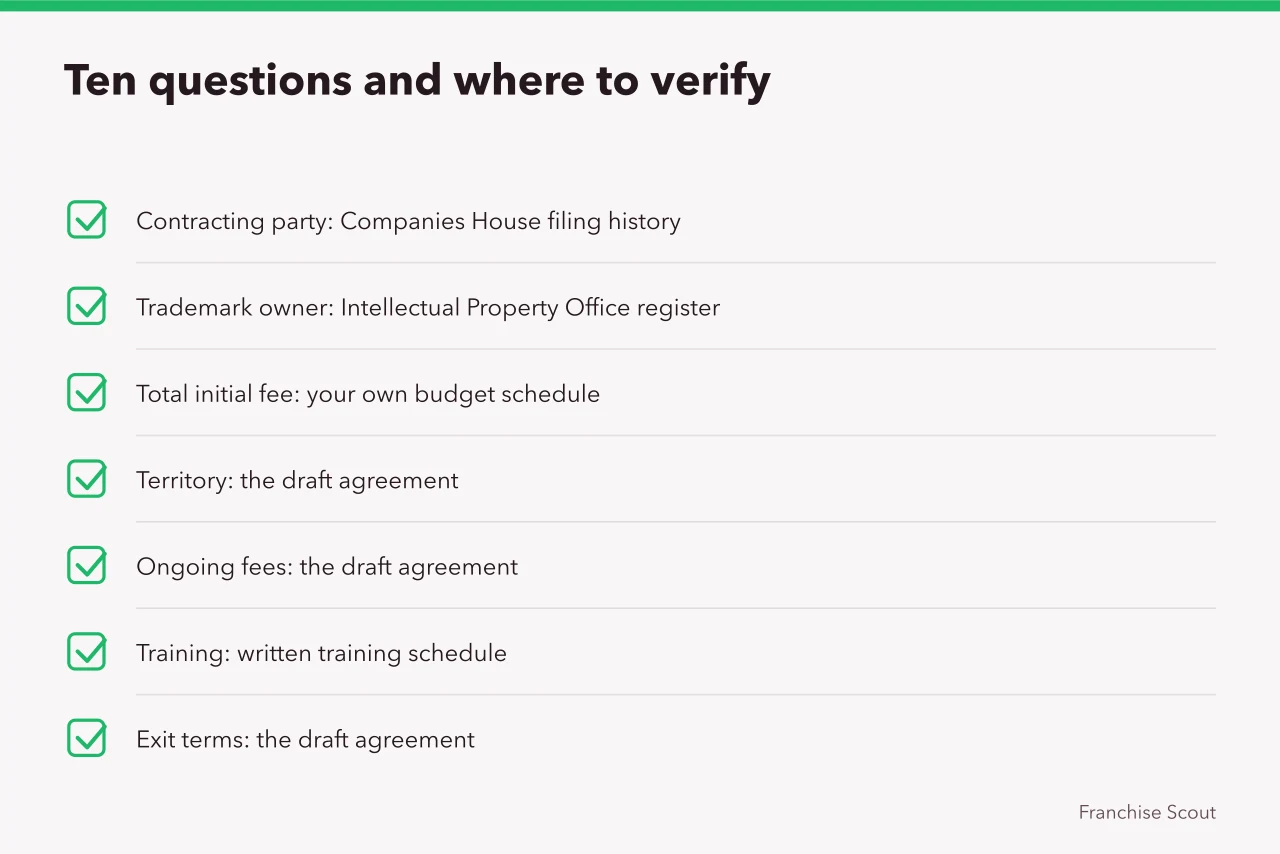
| Question | What a documented answer contains | Where to verify |
|---|---|---|
| Who is the contracting party? | Full legal name and company number | Companies House filing history |
| Who owns the trademark? | Registered owner, class and renewal date | Intellectual Property Office register |
| What is the total initial fee? | Fee, VAT treatment and what it excludes | Your own budget schedule |
| What territory do I get? | Postcode or radius, exclusivity wording | The draft agreement |
| What are the ongoing fees? | Percentage, sales base and marketing levy | The draft agreement |
| What training is included? | Hours, location, who pays travel | Written training schedule |
| What support is promised? | Named services and response times | The operations manual |
| Can I speak to franchisees? | Introductions to current and former owners | Calls you arrange yourself |
| What are the exit terms? | Renewal, transfer, resale and post-term limits | The draft agreement |
| What if the franchisor is sold? | Change of control and insolvency provisions | The draft agreement |
None of these questions needs a solicitor to ask. They need a franchisor willing to answer in writing.
What a documented answer looks like
On fees, a documented answer names the initial fee, the management services fee as a percentage of a defined sales base, and the marketing levy. It also says whether those figures carry VAT. A dependency is acceptable; an undefined one is not.
On territory, ask for the postcode or radius written into your agreement, plus what happens where two franchisees' areas overlap. Exclusivity promised on a call but missing from the contract is not exclusivity.
On the network, ask for the number of franchisees, openings and closures over the last three years. A franchisor that tracks closures openly is usually better run than one that cannot produce the figure at all.
How to turn answers into a decision
Illustrative figures make the trade-off concrete. If the management services fee is 8% of net sales and your projections show £240,000 of annual sales, that is £19,200 a year before the marketing levy, which you should price separately.
Fee worked on illustrative sales
- 8%management services fee of net sales
- £240,000illustrative annual sales
- £19,200annual fee before marketing levy
Compare that figure against the support you are actually promised. If the fee is fixed but the support is discretionary, you have priced the cost and not the benefit.
If two or three questions come back without documents, treat that as a signal to slow down rather than a reason to walk away. Ask again in writing and keep the replies.
Where the BFA route helps
Ask whether the franchisor is a BFA member before the interview. Members commit to a code of ethics that requires full and accurate written disclosure of material facts before signature. It is a voluntary standard, not a legal one.
Non-members are not automatically poor operators, but you lose a complaints route and a written standard to hold them to. Ask what else the franchisor does to demonstrate the same discipline.
Pre-contract checklist
- Check the franchisor's legal identity and filing history at Companies House, including any change of name or dormant periods.
- Confirm the trademark is registered to the company that will sign your agreement, using the Intellectual Property Office register.
- Check the franchise agreement key clauses on renewal, termination and post-term restrictions before you pay a deposit.
- Ask how your enquiry and customer data will be handled, then compare that with the ICO guide for organisations.
- Take independent legal advice on the agreement, and budget for it separately from the franchise fee.
Common questions
Do I need a solicitor to help ask these questions?
No, but a solicitor should check the answers before you sign. They read the franchise agreement against what you were told and flag any gap between the two.
What if the franchisor will not answer in writing?
Ask once more by email and keep the reply. If a specific figure never arrives, price the risk yourself or walk away. A refusal is an answer.
Should I speak to franchisees who left the network?
Yes, and ask the franchisor to arrange it. Former franchisees give the most useful account of exit terms and resale values.